


About the Toolkit
The Educational Developer Competency Toolkit is a resource developed by the POD Network’s Professional Development Committee (PDC) in an effort to identify key competencies (knowledge, skills, and values) essential to the work of educational developers. The PDC is charged with responding to the diverse professional development needs of POD Network members at various career stages and different institutional types.
The Toolkit contains:
- A framework,
- a lexicon,
- a self-assessment tool,
- and additional resources.
Building upon previous research in this area, we utilized a participatory process to develop a toolkit intended to be inclusive of the diverse individuals and career pathways that comprise the field of educational development. Because of the variety of roles, responsibilities, and career pathways experienced by educational developers, it is likely that not all perspectives are yet represented. The Toolkit is an evolving resource. We anticipate that it will change over time as our field evolves and multiple perspectives are integrated.
Framework: Purpose and Intent
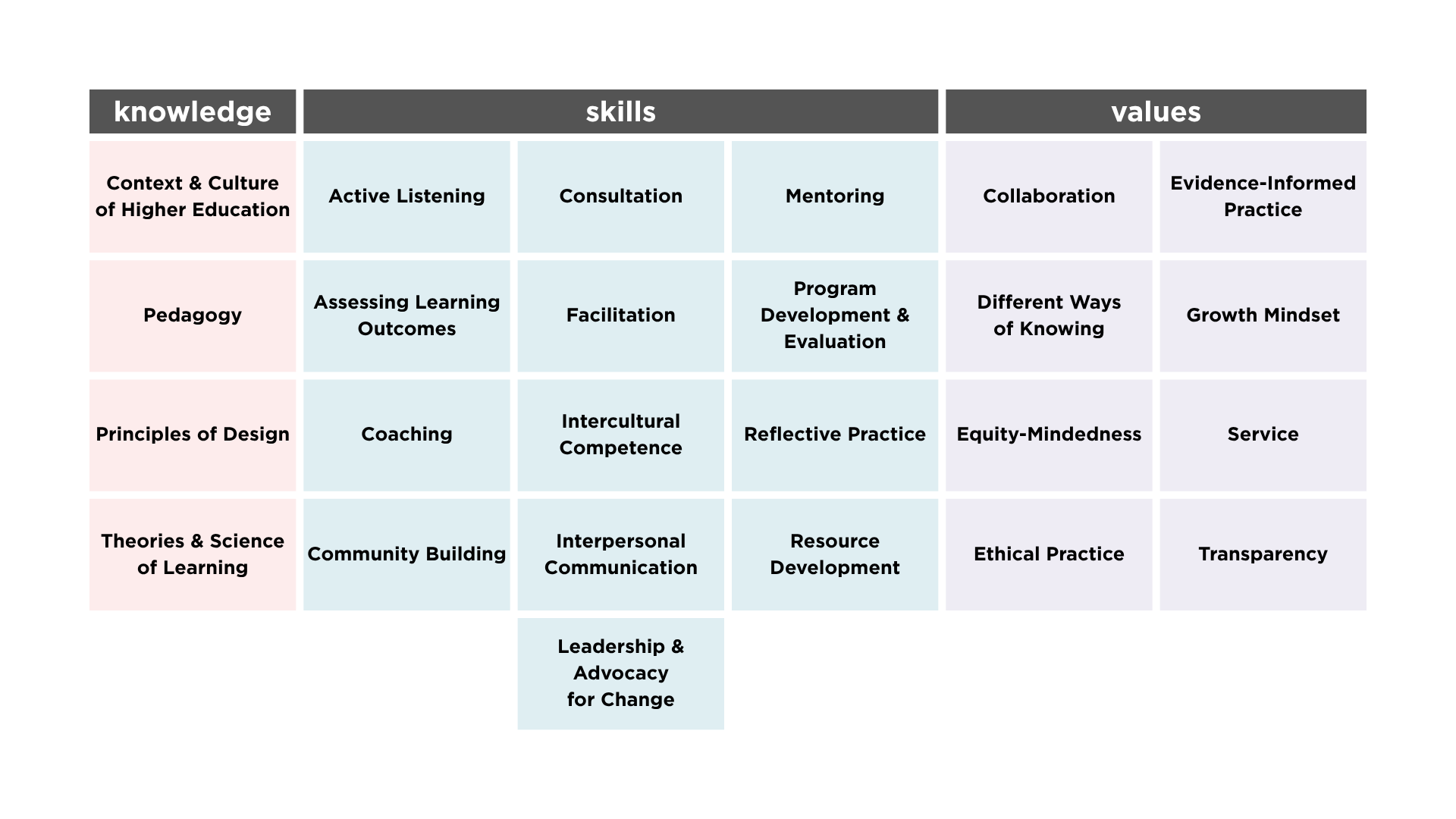
The framework — which identifies three categories of knowledge, skills, and values, and names multiple areas of expertise in each category — aims to articulate competencies critical the work of educational developers. This tool is intended to provide formative guidance and to catalyze conversations that may need to be adapted to local goals and resources. This tool can be used by:
- Educational developers, who are encouraged to use this tool as a means for assessing and furthering their own professional growth and development.
- Directors of centers for teaching and learning, who may find this tool useful for understanding the skills and knowledge of CTL staff to leverage strengths and identify areas for development, collaboration and/or growth of the center.
- Academic leaders and CTL partners, who may benefit from having a shared language for crafting job descriptions, providing resources and professional development opportunities, and framing the work of centers within conversations concerning strategic planning.
Lexicon
Each competency within the framework has two entries:
- Description for Educational Developers: A definition tailored to the work of educational developers in higher education.
- Application for Practice: A more detailed description, including examples, that illustrates what this competency can look like in an educational developer’s work.
Although competencies are grouped together as knowledge, skills, or values, we recognize that there is overlap for many of these competencies.
Knowledge
Description for Educational Developers: The impact of significant movements and forces (historical and current) on higher education and how they intersect with the unique features that can define institutional context and culture.
Application for Practice: The knowledge of the context and culture of higher education entails an educational developer understanding the impact of (historical and current) cultural, political, social, economic, technological etc. movements on higher education and the significant movements and forces (historical and current) within higher education, as well as employing these understandings to address unique features that define individual institutional context and culture. Educational developers use context and culture as a lens for designing, evaluating, and improving educational development programs, resources, and services that meet the needs of their institution.
Description for Educational Developers: The methods and practices of teaching and learning. Such a knowledge base may develop through studying scholarship of teaching, learning, and other related topics, such as psychology, and working with educators and learning about their individual experiences. Andragogy is a subfield of pedagogy that focuses on the unique needs of adult learners.
Application for Practice: The knowledge of pedagogy entails an educational developer understanding how the body of knowledge concerning pedagogy (and its subfield andragogy) can guide their support of educators in both traditional (e.g., workshops, consultations) and non-traditional (e.g., resource materials) learning environments through evidence-informed teaching practices. Some educational developers prefer to focus on the principles of the subfield andragogy, given that the vast majority of learners in higher education are adults. As adults, learners in higher education strive for independence and self-actualization and need to understand the why, what, and how of their educational experiences. Educational developers recognize and then share with others that learners’ prior experience(s) are valuable resources in their learning and that adult learners’ motivation is rooted in personal goals, relevance to real-world scenarios, and problem-solving.
Description for Educational Developers: The articulation of learning goals, selection of aligned learning activities, assessment of outcomes, and iterative improvement, among others. There are a multitude of design schemas that educational developers may use (e.g., design thinking, backward design, Analysis, Design, Development, Implementation, and Evaluation (ADDIE), Universal Design for Learning (UDL)).
Application for Practice: Educational developers understand how the use of design principles can span from an individual course with faculty to an institutional curriculum working with curricular teams (e.g., general education). The use of design principles requires an educational developer to be aware of a variety of learning design approaches and offer guidance on how to better help people learn and grow. Educational developers understand how design principles advance the culture of teaching at their institution and how they might incorporate design schemas into their own programming or collaborative work.
Description for Educational Developers: The theories and science of learning that describe the complex process of human development and aim to improve learner outcomes. Integrating these theories and research into programing, resources, and services helps educational developers empower educators to help learners learn more effectively and efficiently.
Application for Practice: The knowledge of theories and science of learning entails an educational developer being cognizant of various theories of learning, such as Experiential Learning Theory or Social Learning Theory, which attempt to describe the complex processes that span biological, psychological, sociological, and technological systems. Educational developers recognize the importance of using these theories to develop learning materials for educators, administrators, and students. Educational developers understand how using learning theories advances the culture of teaching at their institution and how they might incorporate their use of learning theories into their (individual or collaborative) work to identify appropriate program curricula, course structures, learning assessments, and teaching strategies to both advance learning and fit into an overall departmental and/or institutional curriculum.
Skills
Description for Educational Developers: Listening with the intent to understand and responding in a manner that demonstrates such engagement, such as during a consultation or other interaction. Active listening is important for educational developers to build trust with colleagues and ensure that they are acknowledging the other person’s thoughts, ideas, and contributions.
Application for Practice: The skill of active listening entails an educational developer preparing for conversations (intellectually, emotionally, physically), paying attention to what others share, checking for their own understanding, and responding in productive ways. These actions demonstrate engagement with the content of the conversation and with their interlocutor(s). Educational developers hone this skill in teaching environments, where they might be conveying information to others; in learning environments, where they might be working through information offered by others (like consultations); and in building trust with colleagues through acknowledging others’ thoughts, ideas, and contributions.
Description for Educational Developers: Determining whether learners have achieved identified learning goals. For example, educational developers advise educators on how they gather information (data) about learning that is used to evaluate (summative) learning or offer feedback (formative) to help facilitate learning.
Application for Practice: The skill of assessing learning entails an educational developer effectively appraising skill and/or knowledge development in reference to specified learning goals. Learning materializes in various ways, such as cognitive improvement, affective development, and behavioral growth, and across diverse contexts. Educational developers might assess educators’ learning during workshops or through mentoring programs through instruments such as feedback surveys or focus groups. Educational developers might also support educators’ assessment practices, as they move to evaluate learners’ skill and/or knowledge development through summative and/or formative assessments.
Description for Educational Developers: Recognizing the potential of a colleague and providing feedback that encourages their growth.
Application for Practice: The skill of coaching entails an educational developer working with colleagues, educators, or students in ways that inspire those colleagues etc. to maximize their personal and/or professional potential. In their coaching, educational developers recognize the potential of the other person and provide feedback that encourages creativity, productivity, leadership, and growth. Coaching can intersect with other educational developer competencies, such as mentoring and consulting.
Description for Educational Developers: Facilitating a sense of community among individuals by fostering connections and encouraging inclusive collaboration.
Application for Practice: The skill of community building entails an educational developer making intentional moves to convene and support groups of colleagues, educators, students etc. who unite together for a common cause or reason. Educational developers who build communities may communicate community messaging and advertising, frame community guidelines and participatory responsibilities, generate opportunities for relationship development and dialogue, and nurture the growth of new and returning members and leaders. Community building programs common in educational development include communities of practice (CoP), faculty learning communities (FLC), and longer-term professional development programming.
Description for Educational Developers: Engaging in dialogue with a colleague or a small group of colleagues on a particular topic of focus related to the work of the educator(s). Consultations can be spaces to provide guidance, coaching, and other support to educators.
Application for Practice: The skill of consultation entails an educational developer engaging in dialogue with colleagues, administration, educators etc. on teaching and learning related topics. Through these conversations, educational developers may help translate research into practice, hone another’s existing practices, or spark interest in new practices, working to galvanize productive change at individual, system, or institutional-levels. The educational developer recognizes that effective consultations are voluntary, confidential, and non-evaluative. This can include offering feedback, whereby educational developers can convey information about current performance, desirable outcomes, and future directions. Consultations can be spaces to employ other educational developer knowledge, skills, and value competencies (e.g., instructional design schemas, active listening, confidentiality, intercultural competence) and can intersect with other educational developer skills, such as mentoring and coaching.
Description for Educational Developers: Leading initiatives, such as workshops, discussions, institutes, and other educational development programming, to produce intended outcomes. Facilitation is also used to describe the part of the consultation process that focuses on increasing the incorporation of evidence-informed instructional strategies.
Application for Practice: The skill of facilitation entails an educational developer hosting events (e.g., workshops, panels, or discussions) in ways that encourage participation; support productive, focused, and inclusive individual and group work; and reach desired learning outcomes all within scheduled time frames. Facilitators might also craft event agendas, design events, create event materials, and offer follow-up resources.
Description for Educational Developers: Working with colleagues from all backgrounds and identities across differences, which can often require humility and a willingness to learn from and about colleagues.
Application for Practice: The skill of intercultural competence entails an educational developer considering and attending to their own and others’ cultural nuances and socialized perspectives. Developing intercultural awareness and sensitivity is a continuous process of gaining knowledge (e.g., of traditions or of needs) and skills (e.g., humility or willingness to learn about others) that support constructive communication and collaboration to achieve shared goals. Educational developers can use intercultural competence to work with colleagues, educators, students etc. from all backgrounds and identities across differences, learning from and about these colleagues etc.
Description for Educational Developers: Exchanging information, feelings, and meaning with others in ways that respect their attitudes, emotions, and dispositions.
Application for Practice: The skill of interpersonal communication entails an educational developer connecting, questioning, creating meaning, and achieving social goals with colleagues, educators, students etc. through interactions that respect attitudes, emotions, and dispositions. Educational developers skilled at interpersonal communication contribute to and benefit from these socially situated back-and-forths that move beyond simple interactions with others and strive towards complex interactions that treat others as unique human beings each with something to offer. Effective interpersonal communication takes communicative characteristics, such as tone of voice, facial expression, and gestures, into account and intersects with other competencies, such as active listening, collaboration, and equity-mindedness.
Description for Educational Developers: Communicating and/or facilitating change, be that change galvanized by higher education in general or within the institution itself. Such changes often require educational developers to advocate for change, lead change, and educate others about change. Educational developers can be effective change navigators, because they can “lead from the middle” in their position between administration leadership, faculty teaching, and student learning.
Application for Practice: The skill of leadership and advocacy for change entails educational developers (a) learning about teaching and learning related change within higher education or their institutions, (b) communicating new understandings to institutional leadership, and (c) advocating for, leading, and modeling change at their institutions. Educational developers navigate change at many different levels and scales and in various contexts. While navigating change, educational developers can involve a variety of stakeholders, such as students, educators, staff, departments, colleges, and administration/institutional leadership. For example, they might host a panel that includes students, faculty, and administration to discuss how a new teaching practice might play out at their institution. The work of navigating change can also include advocating on behalf of educator or student needs or the needs of educational developers themselves. Educational developers’ unique position at their institution can support them in this work, as they act as translators, conduits, mediators, and connectors.
Description for Educational Developers: Providing guidance and support to others, so that they may grow professionally, develop new skills, and achieve their goals.
Application for Practice: The skill of mentoring often entails an educational developer building a relationship with an individual, so that the relationship provides opportunities to enhance development within and/or beyond a current position. Educational developers might nurture mentees as they onboard into an organization, galvanize skill- and/or knowledge-development important to the organization, or nurture a mentee’s professional growth within specific skill- and/or knowledge domains. Mentoring might come from formalized programming or spontaneously out of shared interests, and it can intersect with other educational developer skills, such as coaching and consulting. An example of mentoring in practice includes participating in consultations and research support. While educational developers may provide career guidance for others in similar roles, typically they do not mentor faculty engaged in the promotion and tenure process. Although mentoring might classically be considered as a committed relationship between one who is more experienced and another who is less experienced or is in need of support and guidance, mentoring can also take place in groups as a way to draw on multiple perspectives and acknowledge that everyone can mentor in some capacity. An example of this is a peer mentoring group that includes individuals with similar levels of experience in an area of expertise.
Description for Educational Developers: Building educational development programming, often through use of program development models or cycles which can include conducting a needs assessment, drafting learning goals, conducting program assessments, and utilizing those assessments to further refine and improve programs.
Application for Practice: The skill of developing programs entails an educational developer productively contributing to the building or rebuilding of evidence-informed, mission-dependent, need-addressing educational development programming. Educational developers can help brainstorm, frame, design, prepare for, facilitate, and evaluate programming. Crucial to this skill is the ability to collect and use feedback through gathering, analyzing, and communicating evidence concerning the quality and impact of the program. Although the term “program” is a broad term and can encompass varied initiatives, such as course design institutes, workshop series, reading groups, or communities of practice, programs typically have particular learning goals, learning activities, and assessments.
Description for Educational Developers: Examining how one’s work might be done differently and which aspects of one’s work might be repeated to engender pedagogical or professional learning. Cultivating these behaviors and this mindset in ourselves and those with whom we work.
Application for Practice: The skill of reflective practice entails an educational developer examining their own behavior and work, scholarship, and/or feedback from others. Effective examination involves attending to different vantage points to check one’s understanding of what has been conveyed and whether suggestions are (in)appropriate or (im)possible. Then, one can identify how one’s work might be done differently and which aspects of one’s work might be repeated to engender pedagogical or professional learning. Educational developers might cultivate reflective behaviors and a reflective mindset in themselves and in those with whom they work, i.e., colleagues, educators, students etc.
Description for Educational Developers: Designing materials that can support colleagues’ and/or students’ work. Resources might include a review of the literature, recommendations, training materials, as well as case studies or examples. Additionally, resources can take on various forms such as print, video, audio, a website, or general digital resources.
Application for Practice: The skill of developing resources entails an educational developer productively contributing to the building or rebuilding of evidence-informed, mission-dependent, need-addressing educational development resources. Educational developers can help brainstorm, frame, design, and evaluate resources. Although the term “resource” is a broad term and can encompass varied material types (e.g., literature reviews, trainings, case studies, or recommendations) in varied formats (e.g., print, video, digital), all of these resources should support and/or advance the knowledge and/or skills of colleagues, administrators, educators, students etc.
Values
Description for Educational Developers: Recognizing how seeking out and maintaining effective working relationships with members of their professional community can achieve shared goals.
Application for Practice: The value of collaboration resides in an educational developer who sees the benefits of seeking out and maintaining effective working relationships within the educational development community, the institutional community, or other professional communities to achieve shared goals. Prioritizing collaboration allows educational developers to capitalize on the diverse expertise of others, fostering shared goals. Collaboration benefits from other competencies, such as active listening, intercultural competence, and different ways of knowing. In addition to collaborations with faculty, departments, administration, and students, educational developers may also work with instructional technology services, the library, accessibility services, academic student support, writing centers, and other relevant offices. Collaborations can take many forms, including e co-facilitation of joint programming, co-consultation, co-creation of teaching and learning resources, co-funding of various initiatives, or other collaborative efforts.
Description for Educational Developers: Recognizing the impact that different worldview paradigms impact one’s knowledge, one’s conceptions of knowledge, and one’s learning.
Application for Practice: The value of different ways of knowing entails an educational developer recognizing that different worldview paradigms impact how we (a) conceive of knowledge and learning, (b) articulate how diverse epistemologies influence our roles and beliefs as educators, and (c) navigate conversations that span across a variety of ways of knowing. Educational developers can work through how diverse epistemologies influence their roles and beliefs as educators and as learners. Valuing different ways of knowing can reduce biases and promote equity mindedness.
Description for Educational Developers: Valuing the varied experiences that learners from historically minoritized backgrounds can face in higher education as a result of systemic oppression, and embracing an ethic of care, discernment, and empowerment. Equity-mindedness as a value for an educational developer frames the lens through which they view the various aspects of their work.
Application for Practice: The value of equity-mindedness resides in an educational developer who believes in being aware of learning and teaching-related opportunity gaps, which result from systemic oppression, and working to close or dismantle them. Equity-mindedness can materialize as being race conscious, institutionally focused, evidence informed, systemically aware, and action oriented; equity-mindedness can also materialize as embracing an ethic of care, discernment, and empowerment. Educational developers use equity-mindedness as a lens through which they view their work and ask questions like: Who is benefiting? Who is not? Why is this the case? And what must I do to close this gap or dismantle it?
Description for Educational Developers: Valuing ethical practice as an educational developer and acting with others’ best interests in mind, as elucidated in the Ethical Guidelines for Educational Developers (POD Network).
Application for Practice: The value of ethical practice resides in an educational developer who cares about the principles of integrity, confidentiality, respect, and benevolence and who allows these principles to guide their actions. The ethical standards of centers (e.g., centers for teaching and learning), organizations (e.g., POD), and institutions (e.g., colleges and universities) are expectations conferred by group members concerning (in)appropriate and (un)acceptable behaviors and become the professional standards of practice. Valuing these standards as an organization might encompass using them to guide organizational decisions, using them to settle organizational challenges, and holding members accountable to them. Valuing these standards as an individual might encompass seeing the importance of honesty, professionalism, and best effort. Several competencies, such as evidence-informed practice, reflective practice, and transparency, may also contribute to one’s understanding of ethical practice. The Ethical Guidelines for Educational Developers, as outlined by the POD Network, are currently under revision (2024). However, you can find the previous guidelines at this link: POD Ethical Guidelines.
Description for Educational Developers: Valuing attestation and corroboration, as aligned with the POD Network’s core values, in one’s own work and sharing teaching approaches that are supported by research and scholarship as being effective in advancing learning.
Application for Practice: The value of evidence-informed practice resides in an educational developer who believes in (a) grounding the practices and decisions of their own pedagogy, scholarship, and professionalism in corroborated research and scholarship and (b) sharing with others teaching approaches and learning strategies that are grounded in corroborated research and scholarship. Educational developers also recognize that there are diverse forms of evidence, that there are a variety of inquiry methods, and that contradictions exist within the teaching and learning literature.
Description for Educational Developers: Valuing how everyone, regardless of experience, expertise, or attitude towards teaching and learning, has a potential to develop in their teaching and/or learning. Educational developers can play a critical role in empowering those who do not see their own potential for growth and can actively work to grow and develop themselves.
Application for Practice: The value of growth mindset resides in an educational developer who embraces the idea that learning is elastic, change is possible, improvement is attainable, and that we can learn from failure. Adopting a growth mindset entails believing that all colleagues, administrators, educators, students, etc., who may have wide ranging experience, expertise, and attitudes towards teaching and learning, are capable of intellectual, behavioral, and emotional growth. Educational developers not only empower others to recognize and realize their own growth, but educational developers also see a growth mindset in themselves and actively work to grow and develop personally and professionally, individually and collectively.
Description for Educational Developers: Actively supporting the needs and activities of others (e.g., faculty, staff, students etc.), the institution, or the field of educational development.
Application for Practice: The value of service resides in an educational developer who embraces their supportive role within an organization or institution and who recognizes how their time, energy, and expertise might enable the work of educators, administration, students, colleagues, and/or the field of educational development. Educational developers must balance responsible service, shaping the larger environment often as “background players,” and authoritative leadership, exerting influence on others.
Description for Educational Developers: Practicing and modeling honesty, vulnerability, and/or clarity during interaction with others and during program or resource development.
Application for Practice: The value of transparency resides in an educational developer who believes in and practices open and honest interaction with colleagues, educators, administrators, students, etc. Educational developers who value transparency assist others in their own vulnerability and assist others in using transparent curricular design. Educational developers can also be vulnerable themselves and use transparent design in their own educational developer work. What transparency looks like also varies: Transparency can materialize when one articulates purpose, expectations, and criteria for evaluation while designing an assignment and an accompanying assessment. Additional strategies for transparent teaching can be found by reviewing resources provided by the Transparency in Learning and Teaching project (TILT Higher Ed, n.d.). Transparency can also materialize as sharing through courage, recognizing one’s limits, and humanizing oneself. How an educational developer comes to value and employ transparency can be influenced by their identities, power, privilege, prior experiences, comfort, level of trust, safety, and context. Being transparent and welcoming transparency from others can support examination of existing systems and consideration of multiple perspectives.
Resources
- Self-Assessment Tool (Google Sheet or downloadable Excel) — Use this resource to articulate your experience with the various competencies and chart a path for development in identified competencies.
- Informational Workbook — This resource includes the information contained in the Toolkit (including framework and lexicon).
- Informational Slides — This resource includes the information contained in the Toolkit (including framework and lexicon).
- Informational Poster — This resource is a single-page poster of the framework, namely knowledge, skills, and values competencies.
- Informational Video — This resource is an orientation to the history, purpose, and components of the Toolkit.
The Educational Developer Competency Toolkit © 2024 by the POD Network is licensed under Attribution-NonCommercial-ShareAlike 4.0 International. To view a copy of this license, visit http://creativecommons.org/licenses/by-nc-sa/4.0/